A. Electricity is safe in low voltages and currents. You might have heard this saying, “it’s not the voltage that kills but the current”, well…this is wrong. High voltages would lead to high currents through the equation, V=IR. The higher the voltage, the higher the current. That’s why you’ll see warnings like, high voltage keep off.
Both AC and DC are dangerous in high voltages. Electricity can kill if if flows through a person because it can disrupt the heart, and stop it. Because the human body has a really high resistance, a high enough voltage can increase the temperature and literally fry the person.
In low voltages, AC is more dangerous than DC while in high voltages, the are both dangerous
Thanks for reading!!
AC stands for Alternating Current and DC stands for DirectCurrent.
It isn’t just a issue of smacking the puck hard enough. I’m not really concerned with that sort of limitation. Stick wielding humans can’t make a puck go much faster than about 50 meters a second, but we can assume this puck is launched by some sort of robot or a hypersonic light gas gun.
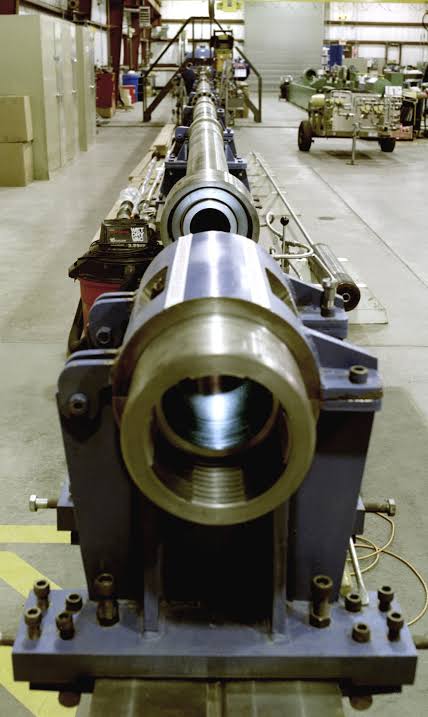
Hypersonic light gas gun (copyright NASA)
The problem is that hockey players are heavy and pucks are not. A goalie(goalkeeper) in full gear outweighs a puck by a factor of about 600. Even the fastest slap shot has less momentum than a 9-year-old skating along at a mile per hour.
Hockey players brace pretty hard against the ice.
Hockey players can also brace pretty hard against the ice. A player skating along at full speed can stop in the space of a few meters, which means the force they are impressing on the ice is substantial.
Through some research, I estimated that the 165-gram puck would have to be moving somewhere between Mach 2 and Mach 8 to knock the goalie backward into the goal and even faster if the goalie was bracing for the hit.
Flying puck
Firing an object at Mach speeds isn’t, in itself, very hard. One of the best methods for doing so is the aforementioned hypersonic light gas gun, which is, at its core, the same mechanism a BB gun uses.
But a hockey puck moving at Mach 8 would have a lot of problems, starting with the fact that the air ahead the puck would compressed and heated very quickly. Though, it wouldn’t be going fast enough to ionize the air and leave a glowing trail like a meteor, but its surface would start to melt or char ( given a long flight time).
Disintegrating puck
The air resistance, however, would slow the puck down very quickly, so a puck going at Mach 8 when it leaves the launcher might be going a fraction of that when it arrives at the goal. And even at Mach 8, the puck probably wouldn’t pass through the goalie’s body. Instead, it would burst apart on impact with the power of a large firecracker, or a small stick of dynamite.
That all for now folks, and I’ll see you… in the next blog post. Bye!
If you have ANY questions relating to science, comment down below and I’ll answer them.
The basic concept makes sense. Temperature is literally kinetic energy. When you stir a cup of water, you’re adding kinetic energy to it, and that energy has to do something. Since nothing out of the ordinary happens to the cup, like the water doesn’t emit light, the energy must be turning to heat.
The reason you don’t perceive the heat is that you’re not adding very much of it. It take an enormous amount of energy to heat water; by volume, it has a greater heat capacity than any other common substance.
If you want to heat water from room temperature to almost boiling in two minutes, you’ll need a vast amount of power, plus extra if you want the water to actually boil. I’ll help with the calculation but the formula is: mass x water heat capacity (4184J/(kgK)) x temperature change. Which is about 700 watts.
Our formula says that if we want to make a hot cup of water in two minutes, we’ll need to have a 700-watt power source. A typical microwave uses about 700 to 1000 watts, and it takes about two minutes to heat a cup of water( depends on the mass of water), so we are approximately correct.
But, how does stirring compare to microwaving? Based on figures from industrial mixer engine report, vigorously stirring a cup of water adds heat at the rate of about a ten-millionth of a watt. That’s absolutely negligible.
The physical effect of stirring is a little bit complex due to many possible scenarios. Most of the heat is carried away from hot water due to air convecting over them so they cool from top to down. Stirring bring fresh hot water from the depths so it could help with cooling.
So, could you boil a cup of water by stirring hard?
No.
The first problem is power, about 700 watts.
You can reduce the power requirement by heating the tea over a longer period of time, but if you reduce it too far, the tea will be cooling as fast or even faster than you’re heating it.
Even if you could turn the spoon fast enough, like hundreds of thousands of stirs a second, fluid dynamics would obstruct you. At those speeds the water would cavitate; a vacuum would form along the path of the spoon and stirring would become ineffective. ( It would even spill from the cup before you reach those speeds.)
And if you stir hard enough that your water cavitates, its surface area will increase very rapidly, and it would cool to room temperature in seconds.
So, No matter how hard you stir a cup of water, it not going to get any considerably warmer
Hey guys! If you want content like this like and comment. I’ll make this kind of descriptive essays
You wake up one morning feeling pretty sluggish. Dragging your feet across the room to get ready for the day. You’re in the bathroom: ready to brush your teeth as you pick up your toothbrush and toothpaste. Thinking to yourself, you remember buying a blue toothpaste. You stare at the mirror ready to brush those teeth. And then, you finally noticed it… you scream as you widened your sleepy eyes this isn’t you.
You rub your eyes vigorously may be it’s a dream [spoiler… it’s not]
You’ve probably watched some movies about an AI (artificial intelligence) robot trying to control humanity. Such as i robot, Avengers age of Ultron. In which AI robots conclude that in other to protect humanity it must destroy it as humanity is its greatest adversary. We usually don’t take this movies seriously as it is great fun. But what made those writers have similar plots, they wrote what they thought. So… are we really our greatest enemy?
This could be true as we destroy ourselves and environment with meaningless wars (physical, chemical, and biological). Leaving serious casualties. We dig up too many portions of the earth causing landslides and earthquakes. Pollute our environment, create life threatening weapons. This list could go on. Are we going to be the civilization which destroys itself? Hopefully not.
As technology advances we tend to use it for evil instead of good. We tend to forget that most dangerous weapons created has always gone to the wrong hands; guns, bombs, nukes, you name it.
Even while using technology for good we always tend to damage our environment and health; global warming, cancer, oil spills etc.
So let’s think about how we use technology. Maybe those AI robots were wrong about humanity. Let’s show them guys. (them meaning this AI robots and any potential alien who has been observing our planet for quite a while)
Hello friends, I’m really sorry I haven’t posted all this while. I’ve been taking a lot of exams this year. But, don’t worry I’m going to start posting really soon.
What do you want me to write about share your ideas in the comments section. Thanks.
….not to be confused with extra terrestrials (extra earth inhabitants)…
When most people think of extraterrestrials, they think of UFOs, ray guns, and aliens. Extraterrestrials can be any life form that didn’t evolve from earth; they can range from complex intelligentspecies to goo in a membrane.
Possible ways life can exist
Scientists can’t really make specific assumptions of life, as it could have evolved from different possible ways in different possible forms. But, one thing we do not about our universe is that: it must obey the laws of science. Therefore, we can make general assumptions.
Scientists believe that liquid water might play an important role in the creation of life. Because water is a universal solvent which can dissolve a wide range of chemicals, creating increasingly complex molecules which might form the basis of life. Unlike most solvents water is simple and may exist throughout the universe
The river of … carbon…?
Carbon might have a role in the possible creation of life: because it has four atomic bonds, which gives it the ability to bind with four other atoms and create complex molecules, and then compounds. Carbon also has the ability to form long chains.
The birth of DNA
The very fundamental basis of life found in every known living thing, the DNA, might just be the final piece to the puzzle [of how life could exist]. An alien specie would have some sort of self-replicating molecule, such as the DNA
And there you have it folks, water, carbon, and the DNA is what could be needed for the creation of life. There are space organizations, such as SETI, searching and looking for clues that could lead to the evidence of life. But no significant achievement or progress has been made. All life is precious, regardless of how little and insignificant it may appear. Do not what SETI would do if they found a bacteria on Mars? Tune in soon for types of civilization.
…not to be confused with Anti-matter movement: the organization against matter…
Atoms are made up of subatomic particles: the proton, neutron, and the electrons. In the 1930’s physicists discovered an alternate twin particle, antiparticle, to normal particles. The first to be discovered was the positron, antielectron, which has a positive charge. It was similar to the electron, except that it carries an opposite charge
What is antimatter
{…let’s annihilate this anti-matter organization seeking to ban the existence of all forms of matter…}
Antimatter is a composed of antiparticles which have equal masses with normal particles, but opposite electromagnetic properties. Antimatter has completely opposite charges to that of matter. Protons are negativity charge, electrons are positively charged, and neutrons… are, um… well, the same neutral particles.
If antimatter comes in contact with matter, the result is an energy releasing annihilation.
Antimatter and technology
{…help the universe by saying “no” to the anti-matter organization anti-matter policies …}
Antimatter has very promising technological applications such as weaponry, energy, and space travel. This can be possible due to the annihilation reaction between regular matter and antimatter to release a lot of energy.
Militaryapplications
You’ve probably seen antimatter weapons in movies. But the most powerful application of antimatter in the military is…the antimatter bomb. The antimatter bomb is far more efficient than the nuclear bomb which is about 1 percent efficient. In theory an antimatter bomb could convert 100 percent of its mass into energy. This would be extremely destructive.
Energyapplications
As mentioned earlier, an an antimatter releases energy when it comes in contact with matter. Methods can be created to make use of that energy to produce heat, light, and electricity with little or no toxic waste. This method of providing energy would be ideal.
Space travel applications
The energy release by matter and antimatter annihilation can be used to propel rockets and spaceships. This he energy in antimatter is about a billion times greater than energy in ordinary rocket fuel. Therefore little amounts of antimatter can move spaceships great distances.
Limitations and problems with antimattertechnology
{…hurray, great job guys, we’ve finally stopped that antimatter organization from implementing it plans. And the government plans to shut it down.}
There are reasons we don’t see antimatter spaceships being launched and zipping through space, they are:
(1) COST: Production of antimatter is very expensive. The current rate of antimatter production is between one-billionth to ten-billionths of a gram per year. In 2004 it cost CERN $20 million to produce several trillionths of a gram of antimatter. At this rate producing a single gram of antimatter would cost $100 quadrillion. So it’s safe to say that antimatter is the most precious substance in the world.
(2) HANDLING AND STORAGE: The handling of antimatter causes serious problems, since any contact between matter and antimatter is destructive. Obviously, containing antimatter in an object would be dangerous as it would react with the wall of the container destructively.
(3) FINDING ANTIMATTER: Antimatter has not been found naturally and I doubt that it will ever be found in our solar system. Our universe is mainly matter than antimatter (this has puzzled physicists). Although not found someday we might find it… But!! It would be to dangerous to travel to antimatter locations with matter based spaceships. How we would mine it is a pretty interesting question.
Radioactivity is dangerous because people can be exposed to a harmful amount without realizing it. Also, continuous exposure to small amount over a long time can lead to some forms of cancer later in life.
Radiation can lead to harmful amount of radium to be stored in one’s bones. Radioactivity from nuclear explosions can cause ingenuous quantities of radiostrontium and radiocaesium to get into food.
Radioactivity and radiation can ionize molecules in human and animal DNA changing it can causing cancer















 Daily Physics