…no math i promise 🤞
Schrödinger’s equation
It isn’t really possible to derive the Schrödinger equation from classical physics. In my textbook (David J. Griffiths), and in a bunch of others, it just kind of appears, and then they show that it works.
I know what you’re thinking—it had to come from somewhere. It is possible to derive the equation without using anything passed calculus 2 (or calculus 3, if you want to be cool). But I did promise no math… unless you’re interested.
Here’s the equation of the hour
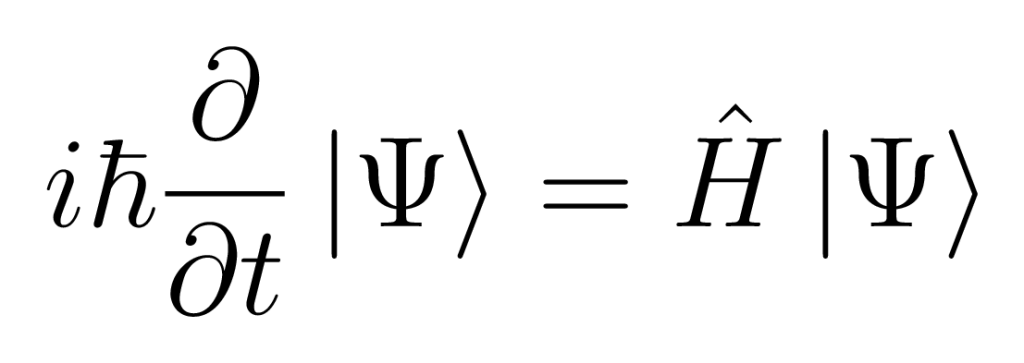
Weirdly, the equation is complex: goes to show how strange things get at the subatomic level (and sometimes even macroscopically, if you check out the latest Nobel Prize in Physics). The ĥ is the reduced Planck constant. The in front is the state vector – in bra-ket notation, it’s a ket here. And the H is the Hamiltonian operator (think of it as a machine that transforms the state vector).
I might continue with this or our “If you didn’t know, now you do” series so the blog continues to be fun.


 Daily Physics